根据残差网络的官方论文可知:
ResNet34的计算图如下:
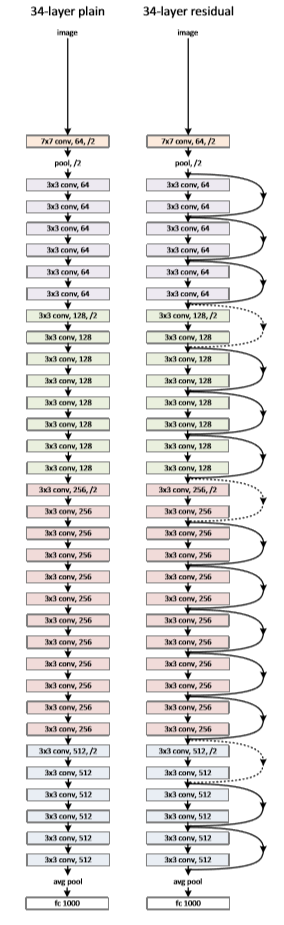
利用pytorch实现的代码如下:
import numpy as np
import torch
import math
# import torch
import torchvision
import torch.nn as nn
import torch.nn.functional as F
import torchvision.models as models
from torch.autograd import Variable
class Block(nn.Module):#残差块
def __init__(self, in_channels, out_channels, stride):
super(Block, self).__init__()
self.conv1 = nn.Sequential(
nn.Conv2d(in_channels=in_channels,out_channels=out_channels,kernel_size=3,stride=stride,padding=1),
nn.BatchNorm2d(out_channels),
nn.ReLU(inplace = True)
)
self.conv2 = nn.Sequential(
nn.Conv2d(in_channels=out_channels, out_channels=out_channels, kernel_size=3, padding=1),
nn.BatchNorm2d(out_channels),
nn.ReLU(inplace=True)
)
self.relu = nn.ReLU(inplace = True)
self.downsample = None
if stride !=1:
self.downsample = nn.Sequential(
nn.Conv2d(in_channels = in_channels,out_channels=out_channels,kernel_size=1,stride=stride),
nn.BatchNorm2d(out_channels)
)
def forward(self,x):
identity = x,
x = self.conv1(x)
x = self.conv2(x)
if self.downsample is not None:
identity = self.downsample(identity)
print("identity",identity.size())
x = x + identity
x = self.relu(x)
return(x)
class ResNet34(nn.Module):
def __init__(self,num_classes):
super(ResNet34,self).__init__()
self.head = nn.Conv2d(in_channels=3,out_channels=64,kernel_size=7,padding=3,stride=2)
self.bn = nn.BatchNorm2d(num_features=64)
self.relu = nn.ReLU(inplace=True)
self.pool = nn.MaxPool2d(kernel_size =3,stride = 2,padding=1)
self.group1 = self._make_group(block=Block, in_channels=64, out_channels=64, blocks=3, stride=1)
self.group2 = self._make_group(block=Block, in_channels=64,out_channels=128,blocks=4, stride=1)
self.group3 = self._make_group(block=Block, in_channels=128,out_channels=256,blocks=6,stride=1)
self.group4 = self._make_group(block=Block, in_channels=256,out_channels=512,blocks=3,stride=1)
self.avgpool = nn.AvgPool2d(kernel_size=7, stride=1)
self.classifier = nn.Linear(in_features=512, out_features=num_classes)
self._initialize_weights()
def forward(self, x):
x = self.head(x)
x = self.bn(x)
x = self.relu(x)
x = self.pool(x)
x = self.group1(x)
x = self.group2(x)
x = self.group3(x)
x = self.group4(x)
x = self.avgpool(x)
x = x.view(x.size(0), -1)
x = self.classifier(x)
return x
def _make_group(self,block,in_channels,out_channels,blocks,stride):
layers = []
layers.append(block(in_channels=in_channels,out_channels=out_channels,stride=stride))
stride = 1
for i in range(blocks):
layers.append(block(in_channels=out_channels, out_channels=out_channels, stride=stride))
return nn.Sequential(*layers)
def _initialize_weights(self):
for m in self.modules():
if isinstance(m, nn.Conv2d):
n = m.kernel_size[0] * m.kernel_size[1] * m.out_channels
m.weight.data.normal_(0, math.sqrt(2. / n))
if m.bias is not None:
m.bias.data.zero_()
elif isinstance(m, nn.BatchNorm2d):
m.weight.data.fill_(1)
m.bias.data.zero_()
elif isinstance(m, nn.Linear):
m.weight.data.normal_(0, 0.01)
m.bias.data.zero_()
i


